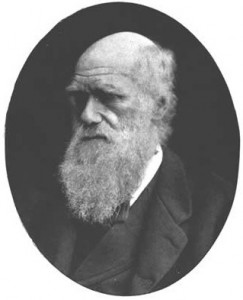
Today we honour the 200th anniversary of the birth of Charles Robert Darwin, one of the giants of the scientific world. Natural Selection, Darwin’s theory of Evolution, is one of the most famous and beautifully written scientific theories the world has ever known.
But Darwin’s theory, over the centuries, has been the target of one of the most prolonged and persistent counterknowledge campaigns in history.
The Church of England were the first opponents to Darwin’s revolutionary new theories. The British press leapt on the idea of man’s ascension from the ape, and the cartoonists went to town. Darwin’s supporters, undeterred, continued to press his theory.
Thomas Henry Huxley, the man known as ‘Darwin’s Bulldog’, clashed with the bombastic Bishop of Oxford, ‘Soapy’ Samuel Wilberforce, in Oxford in 1860. Wilberforce, at the height of the argument, demanded to know if Huxley was descended from an ape “on his mother’s or his father’s side”. At this insult Huxley, turning to another Darwin ally, the surgeon Benjamin Brodie, muttered: “The Lord hath delivered him into mine hands”, then delivered a withering riposte. According to Macmillan’s Magazine:
“On this Mr Huxley slowly and deliberately arose. A slight tall figure stern and pale, very quiet and very grave, he stood before us, and spoke those tremendous words - words which no one seems sure of now, nor I think, could remember just after they were spoken, for their meaning took away our breath, though it left us in no doubt as to what it was. He was not ashamed to have a monkey for his ancestor; but he would be ashamed to be connected with a man who used great gifts to obscure the truth. No one doubted his meaning and the effect was tremendous. One lady fainted and had to be carried out: I, for one, jumped out of my seat; and when in the evening we met at Dr Daubeney’s, every one was eager to congratulate the hero of the day.”
In 1878, four years before Darwin’s death, American Presbyterians at the Niagara Bible Conference founded the Christian Fundamentalist Movement. At this early stage the relatively moderate founders were, for the most part, not diametrically opposed to the idea of Natural Selection. Christian Creationism was not to take shape until after the First World War.
By the 1920’s, Creationism had found a figurehead in Democrat politician William Jennings Bryan. A powerful speaker, Bryan ran for President no less than three times, and later became Woodrow Wilson’s Secretary of State. By 1925, the year of his death, he had published several books and lectured extensively on the subject. One of his books was entitled “The Menace of the Theory of Evolution”.
Bryan was to meet his match, however, in the famous agnostic lawyer Clarence Darrow, and their field of battle was to be the famous Scopes ‘Monkey’ trial of 1925.
24-year-old school football coach John Scopes had, while filling in for a friend, approached the subject of Evolution in a biology class, violating as he did so Tennessee’s Butler Act, which made it unlawful: “to teach any theory that denies the story of the Divine Creation of man as taught in the Bible, and to teach instead that man has descended from a lower order of animals.”
Darrow and Bryan squared up in the courthouse of Dayton, Tennessee, and with the world’s press watching, went to war. This was the second of the titanic clashes between Darwin’s supporters and his critics.
The results, as at the Oxford debate, were mixed. Scopes was convicted, and though he was only lightly sentenced, the state legislatures of Mississippi and Arkansas passed antievolutionary laws copying the Butler act.
But Bryan, technically the victor, was lampooned in the Northern liberal media as being part of an ignorant and backwards South. The famous journalist H. L. Mencken published a barrage of stinging attacks on both Bryan personally and Tennessee residents in general, calling them “Neanderthals” and “morons”.
Darrow became a media darling in the North, and his speeches in Scopes’ defence were widely published. Bryan died soon after the trial ended.
The Scopes trial served only to energise both sides of the Christian Creationism debate. The 20th Century saw Creationism split into several sections, including the hard-line Young Earth Creationists, who take as literal fact every word of the New Testament, and believe that the Earth was created between 6,000 and 10,000 years ago.
Progress has been made since, though perhaps not as much as Darwin, Brodie, Huxley and his other allies might have hoped in 1860. There are still places in America where Evolution must be taught as a theory alongside Creationism, and there are still hard-line fundamentalists who fight to have Natural Selection discredited.
Darwin’s theory, perhaps fittingly, has always had to fight for its survival, and is fighting still. But while the battlegrounds used to be in the Southern states of America, and the main opponents Christians, a new enemy to Natural Selection is beginning to emerge from the shadows in the Middle East.
A worryingly low number of people across the Islamic world, when polled, agree that Darwin’s theory is “probably or most certainly true.” A troublingly low 60% of Americans agree with Natural Selection, but this is eclipsed by Egypt’s 8%, Pakistan’s 14%, Indonesia’s 16% and Turkey’s 22%.
Islamic scholars are divided on the subject of Creation. Some argue that the Qur’an, unlike the Bible, contains no specific timeframe with which to take up arms against scientific fact. These moderate scholars, such as the author Yahiya Emerick, see no conflict between Islam and evolution, saying:
“Because we do not reject the evidence presented to us by Paleontologists (fossil hunters) and other scientists, we can accept some of what they say, also, about the origins of life on Earth and the existence of dinosaurs and other creatures in the fossil record. However, we read in Allah’s book that He caused it to happen and that by studying it we increase our faith in Him. Therefore, we disagree with those who say everything happened without Allah, by mere chance only.”
However, fundamentalist scholars like Nuh Ha Mim Keller, an American convert now living in Jordan, argue that:
“As for claim that man has evolved from a non-human species, this is unbelief (kufr) no matter if we ascribe the process to Allah or to “nature,” because it negates the truth of Adam’s special creation that Allah has revealed in the Qur’an.”
Worryingly, it seems that the latter view is gaining strength. The vicious anti-Evolutionary sentiment in Adnan Oktar’s book “The Evolution Deceit”, circulated for free in Turkey, seems to have become the prevailing view there. Oktar, writing as Harun Yahya, continues to write against Evolution, and to send unsolicited copies to scholars like Richard Dawkins, as well as distributing them in Turkey.
As we celebrate the 200th birthday of the father of Evolution, we must also be aware that this most critical of scientific theories continues to fight for its survival.
Recent Comments